
Community Medicine notes for MBBS, competency by competency
Every page follows the NMC CBME competency list: the key points examiners tick, definitions and mnemonics, the questions that repeat in university exams, my video for each section, and MCQs with the reasoning behind every answer.
CM 1 Concept of Health and Disease
Public health, the definition and determinants of health, the epidemiological triad, natural history, levels of prevention, indicators, demography and communication skills. (CM 1.1 to CM 1.9–1.10)
- CM 1.1 Concept of public health: Winslow, the four phases and Health for All (MBBS Community Medicine Notes)
 Winslow’s definition, the four phases from disease control to Health for All, and why the same jaundice outbreak looks different to a clinician and a public-health doctor. Exam-oriented MBBS notes with MCQs (NMC CM 1.1).
- CM 1.2 Health: definition, dimensions, well-being and determinants (MBBS Community Medicine Notes)The WHO definition and its critique, the dimensions and spectrum of health, well-being, PQLI and HDI, and the determinants of health with Indian examples. Exam-oriented MBBS notes with MCQs (NMC CM 1.2).
- CM 1.3 Agent, host and environment: multifactorial aetiology and risk factors (MBBS Community Medicine Notes)The epidemiological triad, the seven classes of agent, host and environmental factors, and the difference between a risk factor, a risk marker and a risk group. Exam-oriented MBBS notes with MCQs (NMC CM 1.3).
- CM 1.4 Natural history of disease and the web of causation (MBBS Community Medicine Notes)The web of causation, the pre-pathogenesis and pathogenesis phases, and how to draw one natural-history line for TB and diabetes that scores nine, not three. Exam-oriented MBBS notes with MCQs (NMC CM 1.4).
- CM 1.5 Levels of prevention, modes of intervention, spectrum and iceberg of disease (MBBS Community Medicine Notes)Control, elimination and eradication; primordial to tertiary prevention; the five modes of intervention in one table; the spectrum of disease and the iceberg. Exam-oriented MBBS notes with MCQs (NMC CM 1.5).
- CM 1.6 Health promotion and health education: concepts, principles, IEC and BCC (MBBS Community Medicine Notes)The communication machinery, the Ottawa Charter, the four methods of health promotion, the principles of health education, and IEC versus BCC versus SBCC. Exam-oriented MBBS notes with MCQs (NMC CM 1.6).
- CM 1.7 Health indicators: enumerate, describe and know what each one proxies (MBBS Community Medicine Notes)Characteristics and the twelve categories of indicators, mortality and morbidity indicators, DALY and QALY, the SDG-3 targets and India’s numbers. Exam-oriented MBBS notes with MCQs (NMC CM 1.7).
- CM 1.8 Demographic profile of India and its impact on health (MBBS Community Medicine Notes)Size, growth, age and sex composition, dependency and the demographic dividend, literacy and urbanisation, and what each one means for a health system. Exam-oriented MBBS notes with MCQs (NMC CM 1.8).
- CM 1.9–1.10 Communication skills and the doctor–patient relationship (MBBS Community Medicine Notes)The communication process and its barriers, the bases and models of the doctor–patient relationship, informed consent, breaking bad news with SPIKES, and talking to families and communities. Exam-oriented MBBS notes with MCQs (NMC CM 1.9–1.10).




CM 2 Social and Behavioural Factors in Health
Clinico-socio-cultural assessment, culture and the family, socio-economic status, barriers to health and health-seeking behaviour, social psychology and community behaviour, and poverty and social security. (CM 2.1 to CM 2.5)
- CM 2.1 Clinico-socio-cultural and demographic assessment of the individual, family and community (MBBS Community Medicine Notes)How to assess an individual, family or community on four dimensions, the interview and its seven steps, survey versus case study versus field study, the medico-social worker, and the five questions that elicit a social history. Exam-oriented MBBS notes with MCQs (NMC CM 2.1).
- CM 2.2 Socio-cultural factors, the family and assessment of socio-economic status (MBBS Community Medicine Notes)What culture is and how it acts on health, the helpful–harmful–neutral buckets, family types, the six-phase family life cycle, family functions, broken and problem families, social class and the socio-economic status scales. Exam-oriented MBBS notes with MCQs (NMC CM 2.2).
- CM 2.3 Barriers to good health and health-seeking behaviour (MBBS Community Medicine Notes)Health behaviour versus health-seeking behaviour, felt, unfelt and expressed need, the determinants of care-seeking, five groups of barriers, the Three Delays model, and how to mitigate barriers and run the barrier station. Exam-oriented MBBS notes with MCQs (NMC CM 2.3).
- CM 2.4 Social psychology, community behaviour and community relationship (MBBS Community Medicine Notes)The social and behavioural sciences, social psychology and the change ladder, social interaction and socialisation, sociology and medical sociology, village social groups, rural versus urban, and community participation. Exam-oriented MBBS notes with MCQs (NMC CM 2.4).
- CM 2.5 Poverty and social security (MBBS Community Medicine Notes)GDP, GNI and per capita income, purchasing power parity, standard of living, poverty lines and multidimensional poverty, calculating the Global Hunger Index, hidden hunger, social security and ESI, and Ayushman Bharat PM-JAY. Exam-oriented MBBS notes with MCQs (NMC CM 2.5).
CM 3 Environmental Health Problems
Air, noise and radiation hazards, safe and wholesome water, water-borne diseases, disposal of wastes, and housing and health. (CM 3.1 to CM 3.5)
- CM 3.1 Health hazards of pollution: air, noise and radiation (MBBS Community Medicine Notes)Air pollutants and their sources, the health hazards head to toe, the Air Quality Index decoded, prevention and control, noise and radiation, with the exam questions for each. Exam-oriented MBBS notes with MCQs (NMC CM 3.1).
- CM 3.2 Safe and wholesome water: sources, purification, chlorination and standards (MBBS Community Medicine Notes)Safe and wholesome water and its sources, the sanitary well, slow and rapid sand filters, chlorination and the break-point, well disinfection with Horrock’s apparatus, household methods and the drinking-water standards. Exam-oriented MBBS notes with MCQs (NMC CM 3.2).
- CM 3.3 Water-borne diseases: classification, F-diagram, cholera and hepatitis A and E (MBBS Community Medicine Notes)The four classes of water-related disease and the control each one needs, the F-diagram with its primary and secondary barriers, cholera and ORS, and how hepatitis A and E cause epidemic jaundice. Exam-oriented MBBS notes with MCQs (NMC CM 3.3).
- CM 3.4 Disposal of wastes: refuse, excreta, septic tank and sewage (MBBS Community Medicine Notes)Refuse and its six methods of disposal, the four criteria of a sanitary latrine, the RCA water-seal and twin-pit latrines, the septic tank in two stages, and how sewage is treated and judged by BOD. Exam-oriented MBBS notes with MCQs (NMC CM 3.4).
- CM 3.5 Housing and health: healthful housing, overcrowding, ventilation and slums (MBBS Community Medicine Notes)Housing as a residential environment, the six criteria of healthful housing and the standards with their numbers, the three overcrowding tests, ventilation and thermal comfort, and slums and sick buildings. Exam-oriented MBBS notes with MCQs (NMC CM 3.5).
CM 4 Health Promotion and Education
Communication, health education methods and models, health promotion, counselling (GATHER) and evaluating a programme. (CM 4.1 to CM 4.3)
- CM 4.1 Health education: communication, approaches, principles and methods (MBBS Community Medicine Notes)From the communication loop to Dale’s cone: why people who know still don’t change, and the individual, group and mass methods that actually move behaviour. Exam-oriented MBBS notes with MCQs (NMC CM 4.1).
- CM 4.2 Organising health promotion, education and counselling (MBBS Community Medicine Notes)Ottawa Charter, the scope and principles of health education, GATHER counselling, the home visit, community participation, and how to plan a programme that survives a ten-mark question. Exam-oriented MBBS notes with MCQs (NMC CM 4.2).
- CM 4.3 Evaluation of a health promotion and education programme (MBBS Community Medicine Notes)Types of evaluation, the indicators and tools, the six steps, and why a thirty-point rise can still prove nothing. Exam-oriented MBBS notes with MCQs (NMC CM 4.3).


CM 5 Nutrition
Nutrients and requirements, nutritional assessment, nutrition-related disorders, balanced diet, surveillance and rehabilitation, national nutrition programmes, food hygiene, fortification and adulteration. (CM 5.1 to CM 5.8)
- CM 5.1 Sources of nutrients and special nutritional requirements (MBBS Community Medicine Notes)WHO’s definition of nutrition, the four classifications of food, protein quality and the cereal–pulse partnership, fats and fibre, the vitamins and minerals that matter in India, and the ICMR-NIN 2020 EAR, RDA, AI and TUL. Exam-oriented MBBS notes with MCQs (NMC CM 5.1).
- CM 5.2 Nutritional assessment of individuals, families and the community (MBBS Community Medicine Notes)How to define and classify nutritional assessment, measure a child correctly, read Z-scores and growth charts, apply Gomez, IAP, Waterlow, WHO and MUAC grades, use Asian-Indian BMI and waist cut-offs, and choose a diet survey. Exam-oriented MBBS notes with MCQs (NMC CM 5.2).
- CM 5.3 Nutrition-related health disorders: control and management (MBBS Community Medicine Notes)India’s eight nutritional problems with the programme for each, PEM and SAM from definition to the ten steps, the xerophthalmia ladder and vitamin A schedule, Anaemia Mukt Bharat, IDD and iodised salt, fluorosis, lathyrism and the double burden. Exam-oriented MBBS notes with MCQs (NMC CM 5.3).
- CM 5.4 Balanced diet and diet planning for individuals and families (MBBS Community Medicine Notes)The definition and four principles of a balanced diet, the cereal–pulse ratio, My Plate for the Day and the Dietary Guidelines 2024, consumption units, diets in pregnancy and lactation, IYCF and multimix, and therapeutic diets. Exam-oriented MBBS notes with MCQs (NMC CM 5.4).
- CM 5.5 Nutritional surveillance, nutrition education and rehabilitation (MBBS Community Medicine Notes)The definition and five objectives of nutritional surveillance and how India watches through growth monitoring and Poshan Tracker, the HABITS principles of nutrition education, the NRC pathway and the five Ms that decide a child’s plate. Exam-oriented MBBS notes with MCQs (NMC CM 5.5).
- CM 5.6 National nutrition policy and national nutrition programmes (MBBS Community Medicine Notes)The National Nutrition Policy 1993 and its two arms, Anganwadi Services under POSHAN 2.0, POSHAN Abhiyaan’s 2-2-3-2 targets, PM POSHAN, the IFA ladder, vitamin A and NIDDCP, PMMVY and NFSA 2013, and how to evaluate a programme. Exam-oriented MBBS notes with MCQs (NMC CM 5.6).
- CM 5.7 Food hygiene and food-borne disease (MBBS Community Medicine Notes)The WHO framing of food hygiene from farm to fork, the danger zone and five keys, milk hygiene and pasteurisation, meat, fish, egg and vegetable control points, food handlers, the food-poisoning incubation ladder and outbreak investigation. Exam-oriented MBBS notes with MCQs (NMC CM 5.7).
- CM 5.8 Food fortification, food additives and food adulteration (MBBS Community Medicine Notes)Food fortification and the vehicle–fortificant principle, India’s five fortified staples and the +F logo, fortification versus enrichment and supplementation, additives and the ADI, adulterant tests, the four diseases of adulteration and the FSS Act 2006. Exam-oriented MBBS notes with MCQs (NMC CM 5.8).



CM 6 Biostatistics
The research question, classification and presentation of data, tests of significance, sampling, central tendency and dispersion, taught as concepts. (CM 6.1 to CM 6.4)
- CM 6.1 The research question: types, steps and how to formulate one (MBBS Community Medicine Notes)What a research question is, its four types and the design each leads to, the seven steps from a broad topic to one answerable question, FINER and PICO, and how the question becomes an aim, objectives and hypothesis. Exam-oriented MBBS notes with MCQs (NMC CM 6.1).
- CM 6.2 Classification, analysis, interpretation and presentation of data (MBBS Community Medicine Notes)Kinds of data and the four scales, building a frequency distribution and a good table, choosing and drawing bar, pie, histogram, polygon, ogive, line, scatter and maps, and the sources of health information. Exam-oriented MBBS notes with MCQs (NMC CM 6.2).
- CM 6.3 Elementary statistical methods and tests of significance (MBBS Community Medicine Notes)Probability and the normal curve, standard error and confidence limits, the null hypothesis, p value and the two errors, how to choose a test, and the chi-square test, correlation and regression: explained as concepts. Exam-oriented MBBS notes with MCQs (NMC CM 6.3).
- CM 6.4 Sampling, frequency distribution, central tendency and dispersion (MBBS Community Medicine Notes)Why we sample, the four key words and the two errors, every probability and non-probability method with its merits and limits, and the mean, median, mode, range, standard deviation and coefficient of variation. Exam-oriented MBBS notes with MCQs (NMC CM 6.4).


CM 7 Epidemiology
Principles and uses of epidemiology, study designs (case-control, cohort, RCT), and the measures you calculate from them. (CM 7.1 to CM 7.9)
- CM 7.1 Epidemiology: Principles, Concepts and Uses (MBBS Community Medicine Notes)Definition of epidemiology (Last), aims and approach, clinical vs epidemiological approach, the seven uses and the web of causation – exam-oriented notes with MCQs for MBBS Community Medicine (NMC CM 7.1).
- CM 7.2 Infectious-disease epidemiology: transmission, prevention and control (MBBS Community Medicine Notes)CM 7.2 notes for MBBS: modes of transmission, reservoir and carriers, herd immunity, the iceberg of disease, levels of prevention, and control vs elimination vs eradication, with exam questions and MCQs.
- CM 7.3 Sources of epidemiological data (MBBS Community Medicine Notes)Community Medicine · CM 7 Epidemiology · CM 7.3 Sources of epidemiological data Every source of epidemiological data in the order examiners expect, from census,… Read more: CM 7.3 Sources of epidemiological data (MBBS Community Medicine Notes)
- CM 7.4 Morbidity and mortality indicators (MBBS Community Medicine Notes)Community Medicine · CM 7 Epidemiology · CM 7.4 Morbidity and mortality indicators Rate, ratio and proportion done right, every mortality and morbidity indicator defined… Read more: CM 7.4 Morbidity and mortality indicators (MBBS Community Medicine Notes)
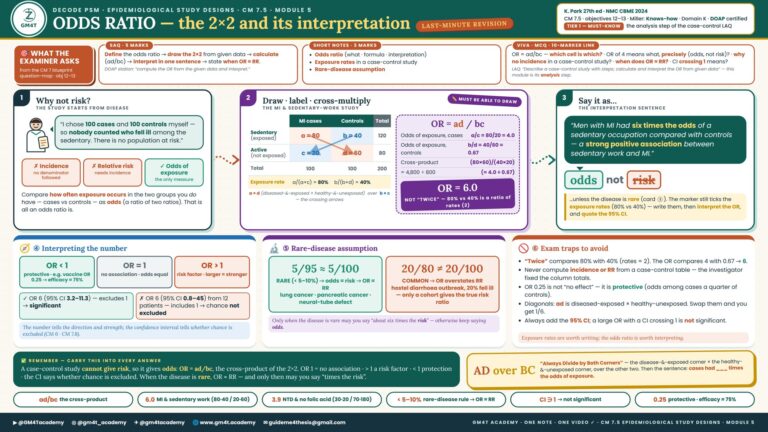
- CM 7.5 Epidemiological Study Designs: Case-Control, Cohort & RCT (MBBS Community Medicine Notes)Classification of study designs, descriptive studies, case-control and cohort studies with odds ratio, relative and attributable risk, and randomised controlled trials – exam-oriented MBBS notes with videos and MCQs (NMC CM 7.5).
- CM 7.6 Screening and the validity of a screening test (MBBS Community Medicine Notes)Community Medicine · CM 7 Epidemiology · CM 7.6 Screening and the validity of a screening test Screening versus diagnosis, the criteria for a good… Read more: CM 7.6 Screening and the validity of a screening test (MBBS Community Medicine Notes)
- CM 7.7 Investigation of an epidemic and its control (MBBS Community Medicine Notes)Community Medicine · CM 7 Epidemiology · CM 7.7 Investigation of an epidemic and its control The ten steps of investigating an epidemic in order,… Read more: CM 7.7 Investigation of an epidemic and its control (MBBS Community Medicine Notes)
- CM 7.8 Association, causation and bias (MBBS Community Medicine Notes)Community Medicine · CM 7 Epidemiology · CM 7.8 Association, causation and bias Association versus causation, spurious, indirect and direct associations, Hill’s criteria with the… Read more: CM 7.8 Association, causation and bias (MBBS Community Medicine Notes)
- CM 7.9 Application of computers in epidemiology (MBBS Community Medicine Notes)Community Medicine · CM 7 Epidemiology · CM 7.9 Application of computers in epidemiology How computers turn a questionnaire into a clean data set, the… Read more: CM 7.9 Application of computers in epidemiology (MBBS Community Medicine Notes)



CM 8 Epidemiology of Communicable and Non-Communicable Diseases
Communicable diseases one by one: tuberculosis, vaccine-preventable and respiratory infections, polio, hepatitis, diarrhoea and cholera, typhoid, dengue, malaria, rabies, leprosy and HIV. (CM 8.1-A1 to CM 8.1-E2)
- CM 8.1-A1 Tuberculosis: epidemiology, diagnosis and NTEP (MBBS Community Medicine Notes)The TB chain from agent and droplet nuclei to ARTI, latent infection and preventive treatment, NAAT-based diagnosis, Mantoux and BCG, 2HRZE/4HRE with DOTS, drug resistance, and NTEP with the End TB targets. Exam-oriented MBBS notes with MCQs (NMC CM 8.1-A1).
- CM 8.1-A2 Other vaccine-preventable and respiratory infections: smallpox, chickenpox, influenza, diphtheria, pertussis, meningitis and ARI (MBBS Community Medicine Notes)Smallpox eradication and mpox, chickenpox and mumps, influenza drift and shift with the A-B-C categories, diphtheria and pertussis control, meningococcal chemoprophylaxis, and the 60-50-40 ARI classification. Exam-oriented MBBS notes with MCQs (NMC CM 8.1-A2).
- CM 8.1-B1 Poliomyelitis: surveillance, vaccines and the polio endgame (MBBS Community Medicine Notes)Poliovirus, its silent iceberg and provocative factors, OPV against IPV with India’s schedule and VVM, VAPP against VDPV and the 2016 switch, AFP surveillance with its two indicators, and certification and the endgame. Exam-oriented MBBS notes with MCQs (NMC CM 8.1-B1).
- CM 8.1-B2 Viral hepatitis: five viruses, two routes and prevention (MBBS Community Medicine Notes)The five hepatitis viruses on two routes, the age shift of A and the danger of E in pregnancy, hepatitis B carriers and serological markers, the birth dose with HBIG, and hepatitis C cure under the national programme. Exam-oriented MBBS notes with MCQs (NMC CM 8.1-B2).
- CM 8.1-B3 Acute diarrhoeal diseases and cholera: ORS, zinc and control (MBBS Community Medicine Notes)Diarrhoea defined and typed, dehydration assessed for Plans A, B and C, low-osmolarity ORS and zinc, the seven-point control plan, and cholera from El Tor and carriers to outbreak control, well chlorination and oral vaccine. Exam-oriented MBBS notes with MCQs (NMC CM 8.1-B3).
- CM 8.1-B5 Typhoid fever: carriers, diagnosis and food and water safety (MBBS Community Medicine Notes)Salmonella Typhi and its carriers, the five Fs with water-borne against food-borne outbreaks, the test for each week and the limits of the Widal test, drug resistance, and control with TCV and Vi vaccines. Exam-oriented MBBS notes with MCQs (NMC CM 8.1-B5).
- CM 8.1-C1 Dengue and chikungunya: vector, critical phase, classification and control (MBBS Community Medicine Notes)The dengue virus, the Aedes vector and the house, container and Breteau indices, the WHO 2009 classification and critical phase, test timing, fluid therapy, integrated vector management and the dengue–chikungunya contrast. Exam-oriented MBBS notes with MCQs (NMC CM 8.1-C1).
- CM 8.1-C2 Malaria: agent, vector, diagnosis, drug policy, indices and elimination (MBBS Community Medicine Notes)The five Plasmodium species, the life cycle and India’s six primary Anopheles vectors, relapse versus recrudescence, severe malaria, the national drug policy, API–ABER–SPR, IRS and LLINs, and the elimination framework. Exam-oriented MBBS notes with MCQs (NMC CM 8.1-C2).
- CM 8.1-D1 Rabies: epidemiology, bite care and prevention (MBBS Community Medicine Notes)The rabies virus and its urban and sylvatic cycles, furious versus paralytic rabies and the 10-day rule, WHO bite categories and wound toilet, Essen, Zagreb and Thai Red Cross schedules, RIG doses, PrEP and Zero by 30. Exam-oriented MBBS notes with MCQs (NMC CM 8.1-D1).
- CM 8.1-E1 Leprosy: classification, MDT and disability prevention (MBBS Community Medicine Notes)Mycobacterium leprae and its spread, Ridley-Jopling and PB/MB classification, the three cardinal signs and smear indices, the 2025 three-drug MDT, lepra reactions and disability grading, NLEP indicators, PEP and rehabilitation. Exam-oriented MBBS notes with MCQs (NMC CM 8.1-E1).
- CM 8.1-E2 HIV/AIDS: epidemiology, diagnosis, treatment as prevention and NACP (MBBS Community Medicine Notes)HIV as a retrovirus and India’s concentrated epidemic, routes and their efficiency, the window period and WHO staging, the three-test algorithm and counselling, TLD and U = U, PPTCT, PEP and PrEP, NACP-V, the 2017 Act and TB-HIV. Exam-oriented MBBS notes with MCQs (NMC CM 8.1-E2).



CM 9 Demography and Vital Statistics
Demography and the demographic cycle, fertility and demographic indices, the sex ratio, population dynamics, the National Population Policy and the sources of health information. (CM 9.1 to CM 9.6)
- CM 9.1 Demography, the demographic cycle and vital statistics (MBBS Community Medicine Notes)Demography and the balance equation, the five stages of the demographic cycle, why India sits in stage 3 yet keeps growing, growth rate and doubling time, and the vital events, rates and uses of vital statistics. Exam-oriented MBBS notes with MCQs (NMC CM 9.1).
- CM 9.2 Demographic and fertility indices: definitions, formulae and interpretation (MBBS Community Medicine Notes)Rate, ratio and proportion, India’s demographic profile and dependency ratio, the determinants of fertility, and every fertility index from CBR, GFR and ASFR to TFR, GRR and NRR, plus the population pyramid. Exam-oriented MBBS notes with MCQs (NMC CM 9.2).
- CM 9.3 The declining sex ratio: causes, implications and the law (MBBS Community Medicine Notes)The three sex ratios and which one detects sex selection, India’s trend from 1901, the causes grouped by channel, social and health implications, the PC&PNDT and MTP Acts, and the remedies including your own duty. Exam-oriented MBBS notes with MCQs (NMC CM 9.3).
- CM 9.4 Population explosion and population dynamics (MBBS Community Medicine Notes)Population explosion and India’s growth since the Great Divide, the causes on both the mortality and fertility side, the consequences, migration and urbanization, the demographic dividend, ageing and the measures for stabilisation. Exam-oriented MBBS notes with MCQs (NMC CM 9.4).
- CM 9.5 The National Population Policy 2000 (MBBS Community Medicine Notes)How Indian population policy moved from 1952 through the 1976 coercive episode to the voluntary, target-free NPP 2000: its three objectives, the socio-demographic goals, the National Commission on Population and an honest verdict. Exam-oriented MBBS notes with MCQs (NMC CM 9.5).
- CM 9.6 Sources of health information (MBBS Community Medicine Notes)The six groups of health information sources in India: the census and Census 2027, the Civil Registration System, the SRS dual-record design, NFHS and other surveys, notification, records, cancer registries and record linkage. Exam-oriented MBBS notes with MCQs (NMC CM 9.6).




CM 10 Reproductive, Maternal and Child Health
RMNCH and the MCH care package, high-risk groups and MCH indicators, local customs, RMNCH+A, immunization and IMNCI, family planning, the Family Welfare Programme, adolescent health (ARSH, RKSK) and gender issues. (CM 10.1 to CM 10.9)
- CM 10.1 Current status of RMNCH and the whole MCH care package (MBBS Community Medicine Notes)The RCH programme and its ten components, the target-free approach, GATHER counselling and unmet need, antenatal, intranatal and postnatal care, the newborn and the under-five: the heaviest block in CM 10.
- CM 10.2 Screening high-risk groups and the indicators of maternal and child health (MBBS Community Medicine Notes)At-risk mothers and newborns, common problems from pregnancy to adolescence, growth monitoring, and the MCH indicators (MMR, IMR, NMR, U5MR) defined, calculated and explained.
- CM 10.3 Local customs and practices in pregnancy, childbirth, lactation and child feeding (MBBS Community Medicine Notes)Harmful, harmless and beneficial customs around pregnancy, childbirth, lactation and child feeding, and how a doctor modifies a harmful practice without losing the community.
- CM 10.4 RMNCH+A: child survival and safe motherhood interventions (MBBS Community Medicine Notes)RCH-I to RMNCH+A, the continuum of care and the 5×5 matrix, JSY, JSSK, PMSMA, LaQshya and the child-survival interventions an examiner expects you to organise.
- CM 10.5 Immunization and IMNCI: the UIP, the cold chain and the sick child (MBBS Community Medicine Notes)The National Immunization Schedule vaccine by vaccine, the cold chain, Mission Indradhanush, AEFI and the IMNCI case-management approach.
- CM 10.6 Family planning methods: classification, advantages and shortcomings (MBBS Community Medicine Notes)Eligible couples and CPR, then every method from barrier to IUCD, hormonal and emergency contraception and sterilisation, with the advantages and shortcomings each long answer needs.
- CM 10.7 The Family Welfare Programme: basis, principles, organisation and operations (MBBS Community Medicine Notes)Basis and principles of the programme, its organisation from centre to sub-centre, technical and operational aspects, and the National Population Policy.
- CM 10.8 Adolescent health: physiology, problems, clinical management and ARSH (MBBS Community Medicine Notes)Who is an adolescent, the nutritional, reproductive and psychosocial problems, principles of clinical management, ARSH standards and the RKSK programme.
- CM 10.9 Gender issues and women empowerment (MBBS Community Medicine Notes)Sex versus gender, gender discrimination and how it is measured, the Gender Inequality Index, PC-PNDT and the declining child sex ratio, and the doctor’s role.





CM 12 Geriatric Health
Ageing and geriatric services, health problems of the aged and their prevention, NPHCE and welfare schemes, and finding the needs of the elderly early. (CM 12.1 to CM 12.5)
- CM 12.1 Concept of geriatric services: ageing, the elderly and who cares (MBBS Community Medicine Notes)Ageing versus senescence, gerontology and its three branches, who counts as elderly and why India is ageing, the triple evils of old age, the home-to-institution spectrum of geriatric services and the UN Decade of Healthy Ageing. Exam-oriented MBBS notes with MCQs (NMC CM 12.1).
- CM 12.2 Health problems of the aged: the four headings (MBBS Community Medicine Notes)Health problems of the aged under four headings (ageing process, long-term illness, psychological, social and economic) with falls and osteoporosis, elder abuse, the geriatric giants and India’s elderly health status. Exam-oriented MBBS notes with MCQs (NMC CM 12.2).
- CM 12.3 Prevention of health problems of the aged: protect, promote, extend (MBBS Community Medicine Notes)Six lifestyle factors for healthy ageing, what population ageing means for PSM, areas amenable to primary, secondary and tertiary prevention, falls and osteoporosis prevention, and caregiver and palliative care. Exam-oriented MBBS notes with MCQs (NMC CM 12.3).
- CM 12.4 National programme for the elderly: NPHCE, policy, law and welfare schemes (MBBS Community Medicine Notes)NPHCE from aim and strategies to services at every level, elderly care at the Ayushman Arogya Mandir, the 1999 National Policy versus the 2007 Senior Citizens Act, and welfare schemes sorted by the evil they fight. Exam-oriented MBBS notes with MCQs (NMC CM 12.4).
- CM 12.5 Identifying the health needs of the elderly early (MBBS Community Medicine Notes)Comprehensive geriatric assessment and its domains, Katz ADL and Lawton IADL scoring, Mini-Cog, GDS and MNA screens, the Timed Up-and-Go, bedside vision and hearing checks, the brown-bag medicine review and WHO ICOPE. Exam-oriented MBBS notes with MCQs (NMC CM 12.5).



CM 16 Health Planning and Management
Health planning, the planning cycle, management techniques, and planning in India from the committees to the national health policies. (CM 16.1 to CM 16.4)
- CM 16.1 Concept of health planning: needs, demands, resources and objectives (MBBS Community Medicine Notes)Why we plan and the three steps, the WHO definitions of health planning and health needs, needs versus demands, the seven resources, goal, objective and target kept apart, and the plan as a blueprint with five elements. Exam-oriented MBBS notes with MCQs (NMC CM 16.1).
- CM 16.2 The planning cycle: eight steps from situation to evaluation (MBBS Community Medicine Notes)The eight-step planning cycle in order: situation analysis with its seven minimum data items, objectives and resources, priorities and alternate plans, the written plan, implementation, monitoring and WHO-defined evaluation. Exam-oriented MBBS notes with MCQs (NMC CM 16.2).
- CM 16.3 Health management techniques: behavioural and quantitative (MBBS Community Medicine Notes)Management and its four activities, the five behavioural and ten quantitative techniques, cost-benefit versus cost-effectiveness, PERT and CPM with the critical path, PPBS, zero budgeting and work sampling. Exam-oriented MBBS notes with MCQs (NMC CM 16.3).
- CM 16.4 Health planning in India and national health policies (MBBS Community Medicine Notes)Planning Commission to NITI Aayog, the committees from Bhore to Bajaj, NHP 1983, 2002 and 2017, NHM and Ayushman Bharat, the health system from Centre to Panchayat, evaluation of health services and the milestone line. Exam-oriented MBBS notes with MCQs (NMC CM 16.4).



CM 17 Health Care of the Community
Levels of health care, community diagnosis, primary health care from Alma-Ata to Astana, health policies and global goals, and health care delivery in India. (CM 17.1 to CM 17.5)
- CM 17.1 Health care of the community: levels, comprehensive care, Health for All (MBBS Community Medicine Notes)Health care versus medical care, the three levels and two-way referral, the Bhore Committee’s comprehensive health care, basic health services of 1965, Health for All and its equity principle, and the health team. Exam-oriented MBBS notes with MCQs (NMC CM 17.1).
- CM 17.2 Community diagnosis: from village data to a prioritised problem list (MBBS Community Medicine Notes)How to make a community diagnosis: its two definitions and three purposes, the contrast with clinical diagnosis, the four data blocks and sources, the eight steps, felt and normative needs, priority criteria and community treatment. Exam-oriented MBBS notes with MCQs (NMC CM 17.2).
- CM 17.3 Primary health care: Alma-Ata, elements, principles and Astana (MBBS Community Medicine Notes)The Alma-Ata definition of primary health care clause by clause, its eight essential elements and four principles, what 1978 changed, the Astana Declaration and UHC, and how India delivers primary health care today. Exam-oriented MBBS notes with MCQs (NMC CM 17.3).
- CM 17.4 Health policies and global goals: HFA, NHPs, MDGs and SDGs (MBBS Community Medicine Notes)India’s health policies from the HFA/2000 strategy and NHP 1983 through NHP 2002 and NHP 2017, the MDGs and SDG 3 with their targets, and where India now stands against each with source and year. Exam-oriented MBBS notes with MCQs (NMC CM 17.4).
- CM 17.5 Health care delivery in India: sectors, three tiers, IPHS and Ayushman Bharat (MBBS Community Medicine Notes)The input–process–output model and India’s health problems, the five sectors and health administration, the three-tier rural infrastructure with IPHS 2022 norms and FRU criteria, the health team, and Ayushman Bharat, NUHM and ESI. Exam-oriented MBBS notes with MCQs (NMC CM 17.5).



More pages are on the way, and videos are added to each page as they are released. Join the Telegram channel to hear when they do.
Practise on the dashboard
Each page is the free summary. The learning dashboard has every module, MCQs that mark themselves with the ruling-out logic, flashcards and model answers. CM 7 Epidemiology is free to try, no login needed.
Open the CM 7 dashboard · free⬇ Download free notes PDFYouTube channelHow can we help you with your learning today?